How is PPTA responding to the changes?
Tirotiro Anō – looking again with fresh eyes
PPTA Te Wehengarua has commissioned a panel of highly experienced and diverse educationalists to monitor and review the changes to New Zealand’s national secondary school qualifications.
The panel includes respected educators, academics, sector leaders, and people with a sound understanding of Māori education and the equity index. It represents a wide range of opinions on senior secondary school assessment.
Kate Gainsford, former PPTA president, former chair of the Secondary Principals’ Council and former principal of Aotea College, and Melissa Denzler, Kaitohu Mātauranga/Education Advisor for the NZ Council of Educational Research, will co-chair the panel.
Kate Gainsford says she looks forward to working with panel members to help ensure that these far-reaching changes are being developed and implemented thoughtfully and comprehensively.
The panel’s work will be completed in two phases.
The first phase consists of an analysis of what is currently known about the changes, what concerns emerge, what evidence is missing and what further work is required before sound decisions can be made. This work will be completed before PPTA’s Annual Conference in September.
The second phase depends on the availability of new information which will be analysed with findings and recommendations developed. This work will continue after Annual Conference.
The name, Tirotiro Anō, provides a link to a report initiated by PPTA almost 30 years ago that reviewed major changes to the secondary school qualifications which resulted in the National Certificate of Educational Achievement.
More about Tirotiro Anō
BERL research
BERL (Business and Economic Research Ltd) is a leading provider of a broad range of economic research, analysis, advice and consultancy for business enterprises, organisations, institutions, community groups, industry associations and public sector clients in Aotearoa New Zealand.
PPTA has contracted BERL to provide us with a ‘credible evidence base’, supported by both qualitative and quantitative data, on the resource implications and impacts on students of the proposed system change.
The research will involve three different focus groups: students, teachers and principals.
The teacher focus groups will capture teachers’ lived experiences of implementing qualifications reforms and their views on impacts for students, teaching practice, workload, resourcing, and equity.
The student focus groups will aim to understand how the qualifications reforms are being experienced by students, including impacts on learning, assessment, wellbeing, subject choices, and future pathways. Student perspectives will be analysed alongside teacher focus groups and school case studies to ensure learner voice is central to the evaluation.
Interviews will take place with principals (or their nominees), with a focus on implementation planning, resourcing, and system impacts.
NCEA replacement proposals - some analysis & considerations
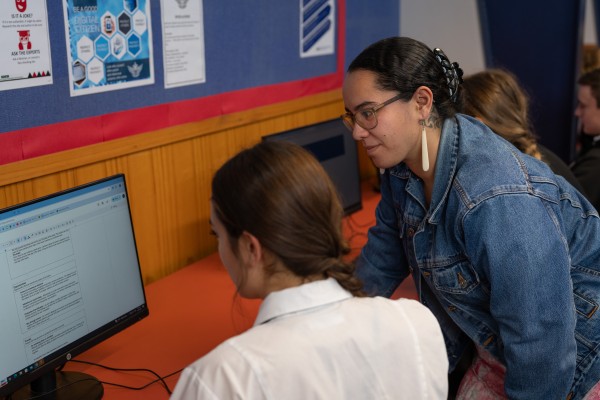
Every young person in Aotearoa New Zealand deserves the chance to succeed in a qualifications and assessment system that meets their needs and keeps them at the centre. NCEA is not perfect but evolution will produce the most settled environment and best outcomes for our learners.
Secondary school qualification details announced - will the kids be alright?

The Minister of Education, Erica Stanford, has announced more details about the new qualification to replace NCEA. Will it actually help students to get where they want to go in life, asks Chris Abercrombie.
Resources
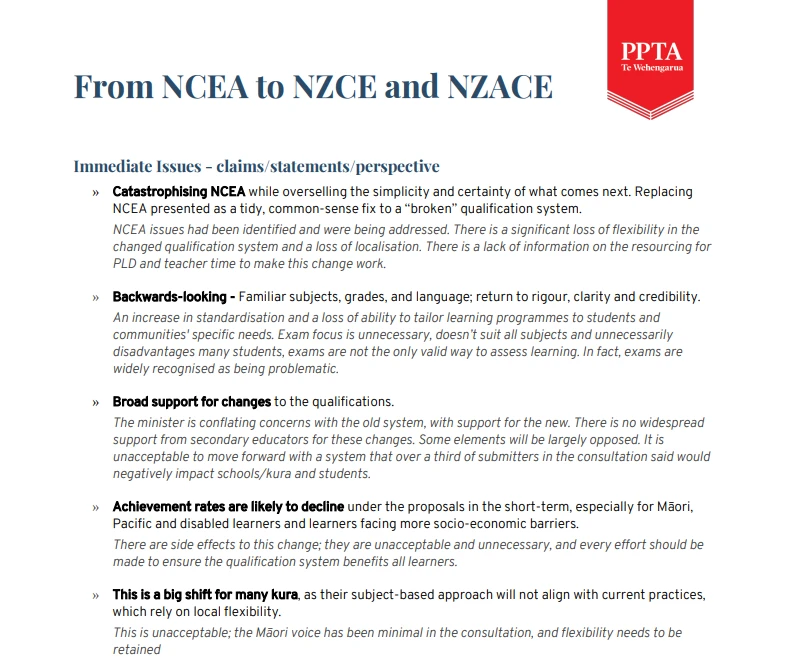
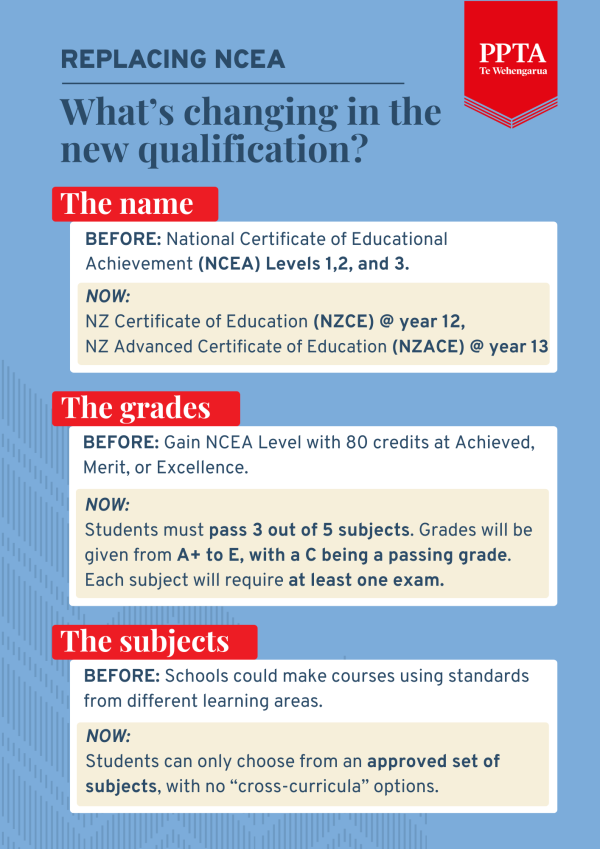
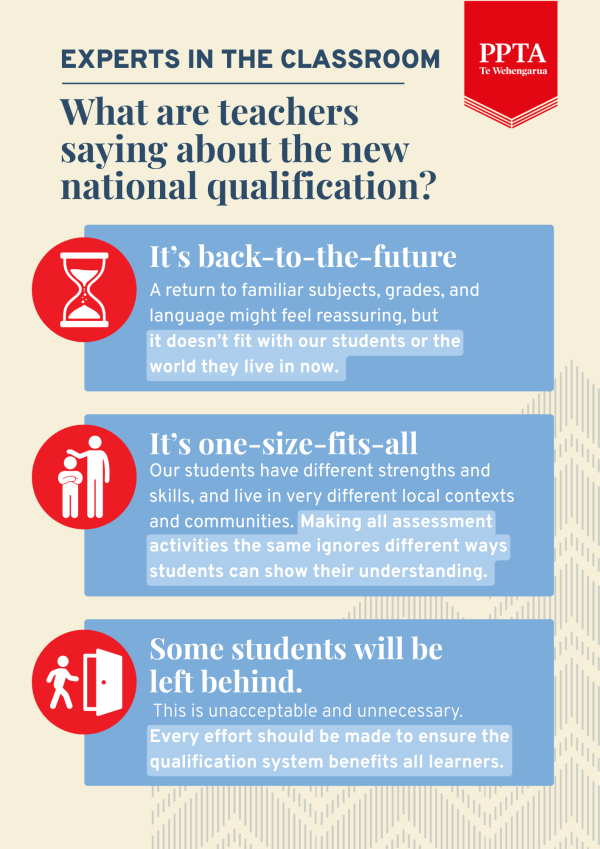
If you want a deeper dive into the concerns about NCEA, the resources below will give you further information. "From NCEA to NZCE and NZACE" provides the most up to date information about the changes and our concerns. You can also see the various concerns PPTA groups raised in the 2025 consultation round in the submissions attached below, noting that there have been changes to the new qualification since that consultation took place.